FSCAC, February 2024: members question FedRAMP's draft plan to move generative AI services near the front of the line
On February 15, 2024, the Federal Secure Cloud Advisory Committee gave FedRAMP spoken feedback on its draft framework to prioritize generative artificial intelligence cloud services, as an executive order required. Members asked about queues, boundaries, and data. There was no vote.
By FedXchange ·
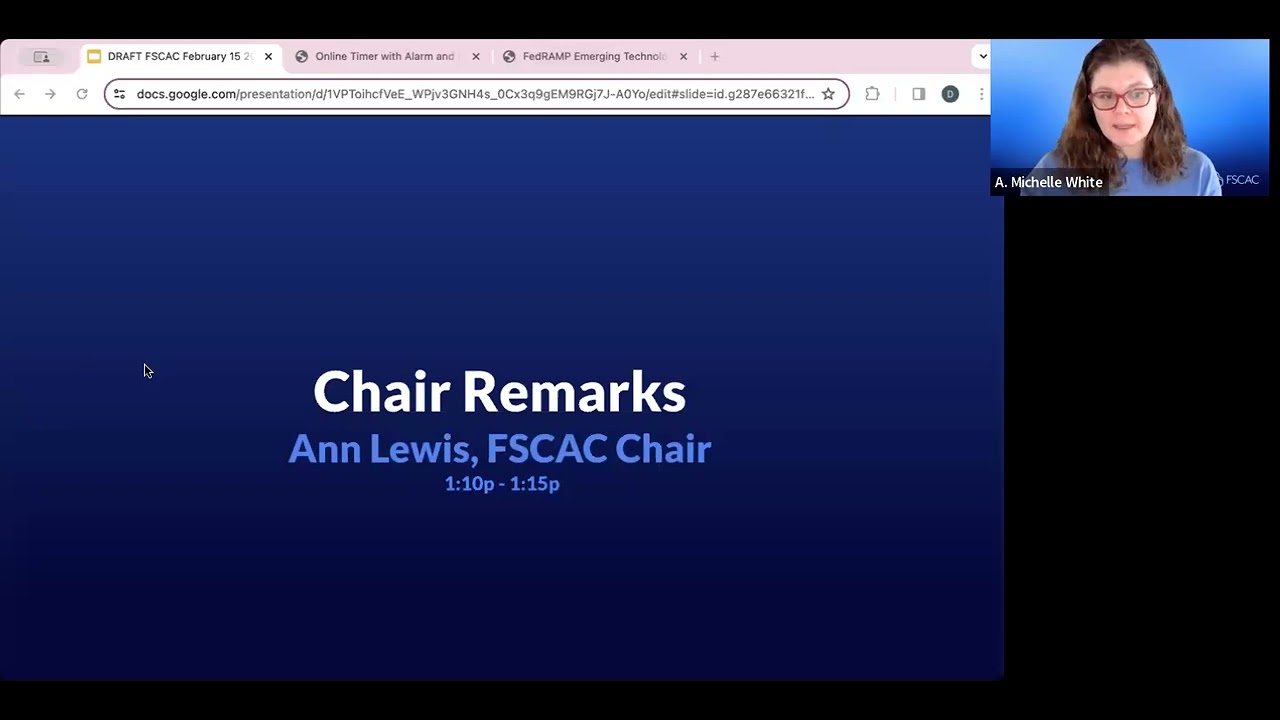 Play the video: Federal Secure Cloud Advisory Committee (FSCAC) February 15 Open Meeting
On February 15, 2024, the Federal Secure Cloud Advisory Committee (FSCAC) met online for less than an hour. The FSCAC is the advisory committee that the FedRAMP Authorization Act requires. It gives advice to the Administrator of the General Services Administration (GSA), the FedRAMP Board, and agencies. FedRAMP is the Federal Risk and Authorization Management Program. The committee's advice does not change FedRAMP's rules.
The meeting had one job. Executive Order 14110, on artificial intelligence (AI), told GSA to consult the FSCAC on a framework for prioritizing emerging technologies in FedRAMP. The Federal Register notice said the meeting was for members' feedback on GSA's draft of that framework.
The meeting came before the FedRAMP Consolidated Rules for 2026. In 2024, FedRAMP's approval was called a "FedRAMP authorization," and speakers used that term. The current terms are "FedRAMP Certification" and "FedRAMP Certified." FedRAMP's What's Changing in 2026 page explains the change.
Quotations in this post are words from the meeting recording, checked against its captions. The post names speakers by their role. The captions give the date as February 5; GSA's minutes and the notice say February 15.
In short:
- What the committee discussed. FedRAMP's Acting Director presented the draft Emerging Technology Prioritization Framework. It would move up to three cloud services for each of three generative AI capabilities near the front of FedRAMP's review line.
- What FedRAMP said it would not change. The review itself, the security baselines, and the authorization boundary. Agencies still decide whether a service works for them.
- What members raised. Fairness to providers already waiting, which parts of an AI service belong inside the boundary, the risk of spilling controlled unclassified information (CUI), and how to stop providers from calling themselves AI just to move up.
- What the committee decided. Nothing formal. The chair said members would give spoken feedback, with no committee deliverable. GSA's minutes record no votes.
- What it meant for agencies and cloud providers. Nothing changed at the meeting. GSA released the final framework on June 27, 2024.
Sources: Executive Order 14110, the draft framework, GSA's minutes for February 15, 2024, GSA's June 27, 2024, blog post, and FedXchange's tracker page for Executive Order 14110.
Read the steps as text
- October 30, 2023. Executive Order 14110 told GSA to issue, within 90 days and in consultation with the FSCAC, a framework to prioritize emerging technologies in FedRAMP.
- January 26, 2024. FedRAMP dated its draft Emerging Technology Prioritization Framework and put it out for public comment.
- February 15, 2024. FedRAMP's Acting Director briefed the FSCAC, and members gave spoken feedback. The committee took no vote.
- June 27, 2024. GSA released the final framework, starting with generative AI.
- January 20, 2025. Executive Order 14148 revoked Executive Order 14110.
What did the executive order ask GSA to do?
Section 10.1(f)(ii) of the order gave GSA 90 days to issue the framework. GSA had to work with the Director of the Office of Management and Budget (OMB) and consult the FSCAC. The framework had to start "with generative AI offerings": chat interfaces built on large language models, code generation and debugging tools, the application programming interfaces (APIs) behind them, and image generators that work from prompts. It had to apply for at least two years.
The committee's designated federal officer said the meeting was meant to complete the consultation the law required.
How would the draft framework work?
The Acting Director said FedRAMP developed it after getting feedback from OMB and from GSA's Technology Transformation Services. The draft says it sits on top of existing review paths and creates no new one. It lets a cloud service provider (CSP) "move near the front of the authorization process." The review then takes as long as usual. The Acting Director compared it to a faster line at a theme park ride:
"The roller coaster ride that you're on takes the same amount of time, irrespective of how you get in the car." — Acting FedRAMP Director
The draft limits the plan to three capabilities at a time. Once three cloud service offerings with a capability are authorized, priority for that capability pauses. The Acting Director said acquisition staff called three the right number for competition. To qualify, a provider would show that the capability is its offering's primary purpose and that agencies want it. The draft also used industry benchmarks to check performance.
Under the draft, the Chief Information Officer (CIO) and Chief Information Security Officer (CISO) Councils nominate technologies, and the FedRAMP Program Management Office (PMO) proposes a list. The FedRAMP Board approves the list. The draft noted that the Board had not yet been formed, so the PMO planned to start with the order's three capabilities.
The Acting Director also said:
"This does not absolve agencies from their authorization responsibilities." — Acting FedRAMP Director
Would FedRAMP change its security requirements for AI?
No, the Acting Director said. A member from Schellman asked whether "additional information" in the draft meant new controls. The answer:
"At this point, we're not altering our FedRAMP security requirements." — Acting FedRAMP Director
The Acting Director added that "our baselines are our baselines." A member from Google asked whether AI services would need a separate authorization boundary. The answer was no.
The GSA CISO said FedRAMP's controls were not written with AI in mind. The member said FedRAMP should check that its baseline matches the risks AI brings. The member also said some providers keep parts of their AI offering outside their FedRAMP boundary, and asked for clearer boundary guidance. The member from the Department of Defense (DoD) raised the risk of CUI spills from AI tools that store and reuse data. The Acting Director said FedRAMP would address both points when it updated its boundary guidance.
Would AI services jump ahead of providers already waiting?
The DoD member said many providers had spent money and time waiting for review, including significant change requests (SCRs) at the Joint Authorization Board (JAB):
"And I think we're going to have to be very, very clear because this is going to have a ripple effect and a monetary effect for the cloud providers that have spent time and money to be in this process." — FSCAC member from the Department of Defense
Answering another member earlier, the Acting Director said the line then ran on "a first in, first authorized model." The framework was for initial authorizations, not SCRs. FedRAMP had not yet decided how far up the queue a service would move.
The member from the National Institute of Standards and Technology (NIST) warned:
"When I've done or had to do prioritization in government approval queues, suddenly everyone is that technology, you know, kind of whether they are or not." — FSCAC member from NIST
The Acting Director said the benchmarks were meant to catch that.
The member from the Department of Veterans Affairs (VA) asked whether an agency could seek priority for other AI, such as a tool for medical notes. The Acting Director said the FedRAMP Board could later direct that, and that a request from several agencies would be a stronger demand signal. Asked later by the member from Google whether the limit was three products per provider or three overall, the Acting Director said FedRAMP had not yet settled it.
What happened next?
No one from the public spoke. The chair said the committee would meet in person on March 28, 2024, to finalize its initial recommendations memo to the GSA Administrator.
On June 27, 2024, GSA released the final framework. GSA said it expected to prioritize up to twelve AI-based cloud services at first. It replaced the benchmarks with AI model cards and took requests through August 31, 2024. On January 20, 2025, Executive Order 14148 revoked Executive Order 14110, according to FedXchange's tracker page for the order.
Sources
- FedXchange tracker: Federal Secure Cloud Advisory Committee (FSCAC) February 15 Open Meeting
- YouTube: Federal Secure Cloud Advisory Committee (FSCAC) February 15 Open Meeting
- GSA: FSCAC February 15, 2024, public meeting agenda and minutes
- FedRAMP: Draft Emerging Technology Prioritization Framework, January 26, 2024 (PDF)
- Federal Register: FSCAC notification of upcoming meeting, January 26, 2024 (2024-01579)
- Federal Register: Executive Order 14110, Safe, Secure, and Trustworthy Development and Use of Artificial Intelligence (2023-24283)
- FedXchange tracker: Executive Order 14110
- GSA: Making access to AI a priority, June 27, 2024
- GSA: FSCAC Annual Report to Congress and the GSA Administrator, December 2022 to May 2024 (PDF)
- GSA: Federal Secure Cloud Advisory Committee meetings
- GSA: Federal Secure Cloud Advisory Committee
- FedXchange tracker: FedRAMP Authorization Act (Public Law 117-263, section 5921)
- FedXchange tracker: FedRAMP Consolidated Rules for 2026
- FedRAMP: What's Changing in 2026
Get new posts and federal governance by email
A weekly email on Fridays, an alert on the day the watch finds something new, or both. Free.