FSCAC, May 25, 2023: the first meeting hears OMB's discussion paper and leans toward automation
At its first meeting, the Federal Secure Cloud Advisory Committee discussed an Office of Management and Budget paper on FedRAMP's future. Members leaned toward automation, program support and resourcing, and a federated agency approval idea. No vote was taken.
By FedXchange ·
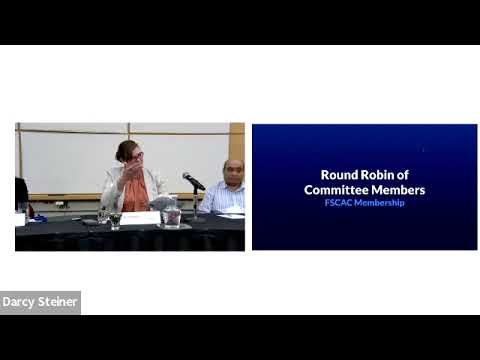 Play the video: FSCAC May 25 2023 Open Meeting Recording
On May 25, 2023, the Federal Secure Cloud Advisory Committee (FSCAC) held its first meeting, at the Ronald Reagan Building in Washington, D.C., and online. The FSCAC is the advisory committee that the FedRAMP Authorization Act creates. FedRAMP is the Federal Risk and Authorization Management Program. The committee gives advice and recommendations. It does not set FedRAMP's rules.
The Federal Register notice said the meeting would be dedicated to the committee determining its first course of action. This recording, posted on July 18, 2023, covers the meeting from the opening to adjournment, except the breaks. A shorter recording of the morning has FedRAMP's briefing.
The meeting came before the FedRAMP Consolidated Rules for 2026. In 2023, FedRAMP's approval was called a "FedRAMP authorization." Under the Consolidated Rules, the term is "FedRAMP Certification," and a certified service is "FedRAMP Certified," as FedRAMP's What's Changing in 2026 page explains. Quotations in this post are words from the video, checked against its captions. The post names speakers by role.
In short:
- What the committee discussed. The Office of Management and Budget (OMB) presented a draft discussion paper on FedRAMP's future. Members gave their own views on governance, reuse, automation, continuous monitoring, and costs for small businesses.
- What members leaned toward. The discussion ended with three areas: automation, program support and resourcing, and a federated idea for agency authorizations to operate (ATOs) that could be piloted with one or two agencies.
- What the committee decided. Nothing. The General Services Administration's (GSA's) minutes record no votes. The chair said members were not yet aligned on a number one topic.
- What it means for agencies and cloud providers. The meeting produced no recommendation. The committee voted on three priorities at its July 20, 2023, meeting.
Sources: the May 25, 2023, meeting video, GSA's minutes for May 25 and July 20, 2023, the FSCAC priorities memo of August 10, 2023, and the FedXchange tracker page for M-24-15.
Read the steps as text
- May 25, 2023, morning. GSA leaders spoke, the chair reviewed the charter, and FedRAMP's acting director briefed members.
- May 25, 2023, afternoon. OMB presented a draft discussion paper, and members gave their views on it.
- May 25, 2023, close. Members named three areas to focus on. Four members of the public spoke. No vote was taken.
- July 20, 2023. Members voted 13 to 0 to work on three priorities at the same time.
- August 10, 2023. The chair's memo told the GSA Administrator the three priorities.
- July 25, 2024. OMB issued its final FedRAMP memo, M-24-15.
What is the committee, and whom does it advise?
The Designated Federal Officer said the committee is required by the James M. Inhofe National Defense Authorization Act for Fiscal Year 2023. Its charter was filed on February 28, 2023. Its duties include advice and recommendations to the GSA Administrator, the FedRAMP Board, and agencies.
The GSA Administrator thanked the 14 members, from the public and private sectors, and said what success would look like:
"creating a FedRAMP process that is scalable, that's secure, and that's easy to use." — GSA Administrator
At the end of the meeting, the chair said one seat, for a small business that provides cloud services, was still being filled.
The chair said requests for work must come from the GSA Administrator, and that advice should be sector-wide, not for one company. Later, a member from the Defense Information Systems Agency (DISA) asked where recommendations go. A GSA official said they go to the GSA Administrator, who decides whether to tell FedRAMP to make changes. The current charter, filed in 2025, says the committee reports to the FedRAMP Director.
What did OMB's discussion paper ask?
OMB's deputy federal chief information officer (CIO) and a senior advisor to the federal CIO presented the paper. GSA's minutes list the session as the "Future Office of Management and Budget memo briefing." The senior advisor said OMB was there to listen:
"This is your committee." — Senior advisor to the federal CIO, OMB
The paper had sections on governance and authorizations, reciprocity with other compliance programs, automation, continuous monitoring, and third-party-led authorizations. On governance, it asked what would change if the FedRAMP Board set requirements and processes instead of reviewing each authorization, as the Joint Authorization Board (JAB) then did.
OMB later published a draft memo for comment on October 27, 2023, and issued the final memo, M-24-15, on July 25, 2024.
What ideas did members raise?
Members spoke as individuals. Their ideas included:
- A federated ATO. The DISA member proposed a program, using a third-party assessor, that checks an agency's ATO process. Once an agency passed, its authorizations would not need a second FedRAMP review. A member from the Department of Health and Human Services supported the idea.
- Keep the exception process. A member from the Securities and Exchange Commission asked OMB not to remove the exception process in the existing FedRAMP memo, so agencies can use tools sooner.
- An authority to test. A member from Google proposed a test phase, so agencies could run test work that does not use live data before the ATO.
- Fewer documented controls. A member from GSA's IT office suggested that a provider could simply state that it meets some controls instead of documenting them. The member also suggested choosing controls by the threats a system faces, which could add or remove controls.
- Clearer guidance. A member from an assessment firm asked for more timely, authoritative guidance, so providers learn expectations before the end of a review.
The DISA member, whose team was one of the JAB's technical representatives, said the authorizations the team covered had grown from maybe 18 or 20 in 2017 to 50, with 94 projected in the queue:
"We cannot sustain this, and we cannot continue to languish with waiting for perfect architecture around automation." — FSCAC member from the Defense Information Systems Agency
What did the committee agree on?
It took no vote. Near the end of the discussion, a speaker summing it up said, "I think I'm hearing some consensus on automation as a priority." The same speaker added program support and resourcing, including documentation and strategic focus, and the federated ATO idea. In closing, the chair said members were not yet 100% aligned on a number one topic. A committee official said the notes and transcript would be posted and that there would be an official vote at the next meeting.
At the July 20, 2023, meeting, GSA's minutes record a 13 to 0 vote, with 1 absent, to work on three priorities. The chair's priorities memo of August 10, 2023, listed them: cloud service provider authorization improvements, continuous monitoring process improvements, and automation initiatives and opportunities.
What did members of the public say?
Four people spoke, according to GSA's minutes. The chief executive officer of a company, who said they did the first cloud ATO in 2010, asked the committee to study FedRAMP's savings for agencies and gave a rough estimate of $500 million. The same speaker said:
"Just don't break it, make it better, but don't break it." — Member of the public
A business development consultant asked the committee to help agencies become sponsors. A small business in process asked for reciprocity for agency-level ATOs. The head of another small business described paying FedRAMP's costs without a loan.
Sources
- FedXchange tracker: FSCAC May 25 2023 Open Meeting Recording
- YouTube: FSCAC May 25 2023 Open Meeting Recording
- GSA: FSCAC May 25, 2023, meeting agenda and minutes
- Federal Register: FSCAC notification of upcoming meeting, May 15, 2023 (2023-10232)
- GSA: FSCAC July 20, 2023, meeting minutes
- GSA: FSCAC priorities memo to the GSA Administrator, August 10, 2023
- GSA: FSCAC charter
- GSA: Federal Secure Cloud Advisory Committee
- FedXchange tracker: FedRAMP Authorization Act (Public Law 117-263, section 5921)
- FedXchange tracker: OMB M-24-15, Modernizing the Federal Risk and Authorization Management Program
- Federal Register: OMB request for comments on updated FedRAMP guidance, October 27, 2023 (2023-23839)
- FedXchange tracker: FedRAMP Consolidated Rules for 2026
- FedRAMP: What's Changing in 2026
- FedXchange: FSCAC, July 20, 2023
- FedXchange tracker: FSCAC May 25 2023 Open Meeting Recording (morning)
Get new posts and federal governance by email
A weekly email on Fridays, an alert on the day the watch finds something new, or both. Free.