FSCAC, October 2024: the committee drafts recommendations on barriers for small cloud providers and faster approvals
On October 3, 2024, the Federal Secure Cloud Advisory Committee agreed on the structure of its 2024 report to the GSA Administrator and drafted its first recommendations on barriers to entry and faster approvals. It took no vote. The drafts are advice, not rules.
By FedXchange ·
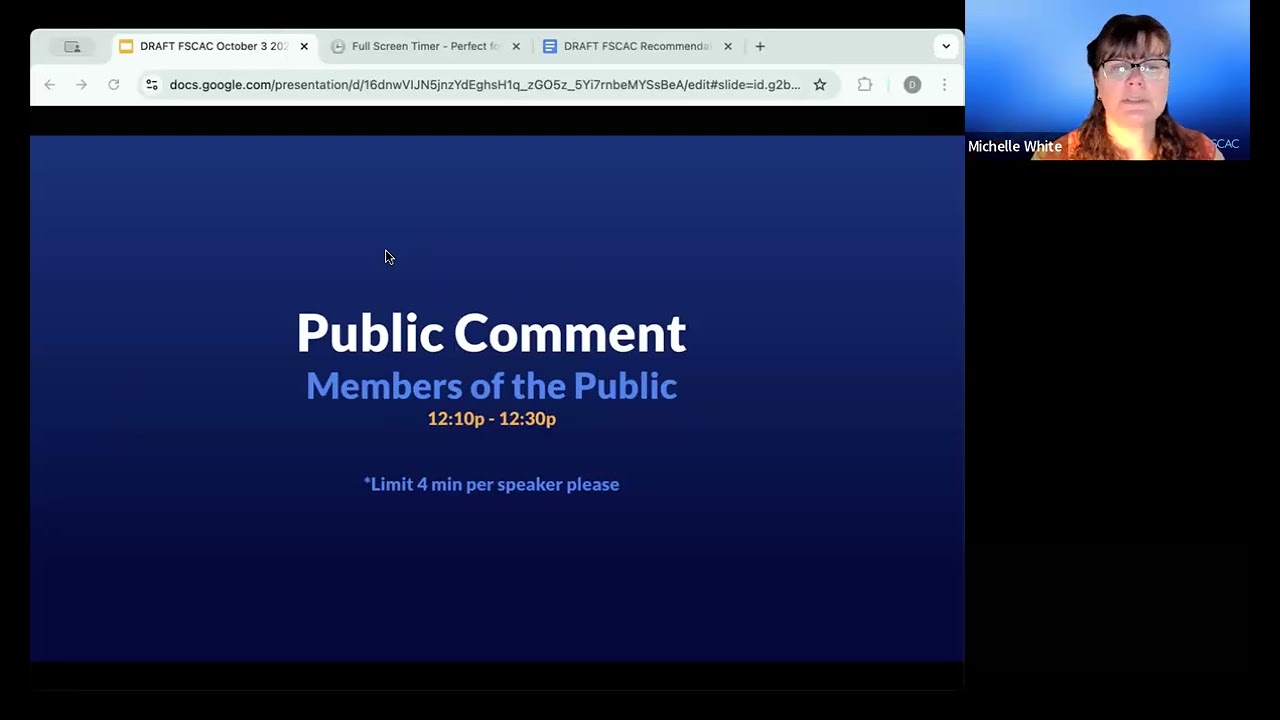 Play the video: Federal Secure Cloud Advisory Committee (FSCAC) October 3, 2024 Open Meeting
On October 3, 2024, the Federal Secure Cloud Advisory Committee (FSCAC) held a virtual public meeting. The FSCAC is the advisory committee that the FedRAMP Authorization Act requires. It gives advice to the Administrator of the General Services Administration (GSA), the FedRAMP Board, and agencies. FedRAMP is the Federal Risk and Authorization Management Program. The committee's recommendations are advice. They do not change FedRAMP's rules.
GSA first set the meeting for October 10 and moved it to October 3 in a Federal Register correction. The meeting had two goals: agree on the structure of the committee's 2024 report to the GSA Administrator, and start drafting recommendations on the committee's first two priorities.
The meeting came before the FedRAMP Consolidated Rules for 2026. In 2024, the program called its approval a "FedRAMP authorization," and members used that term and "authority to operate" (ATO), an agency's approval. The current terms are "FedRAMP Certification" and "FedRAMP Certified." FedRAMP's What's Changing in 2026 page says the new term avoids confusing the two.
Quotations in this post are words from the meeting recording, checked against its captions. The post names speakers by their role.
In short:
- What the committee decided. Members agreed to use the same report structure as the year before. The chair said: "Nothing on the report is final until we hold an official vote." The committee took no vote.
- What it discussed. Barriers that keep small cloud service providers out of the federal market, and ways to make FedRAMP approval faster and cheaper.
- What it drafted. Ten draft recommendations across the two priorities. They include automation, a help program for small providers, shared security packages that small providers inherit from large ones, a short list of critical controls, and possible grants or cost sharing.
- What it could mean for agencies and cloud providers. Nothing changed at the time. The drafts were a first step toward advice to the GSA Administrator, who decides whether to act.
Sources: the October 3, 2024, meeting video and GSA's FSCAC meeting pages and minutes. The drafts are advice to the GSA Administrator, not FedRAMP rules.
Read the steps as text
- February 28, 2023. The committee's charter was filed under the Federal Advisory Committee Act.
- July 16, 2024. Members refined their top priorities and chose two to work on first.
- September 12, 2024. Members heard from the Office of Management and Budget about its FedRAMP memo, and from industry and agency liaisons.
- October 3, 2024. Members agreed on the report's structure and drafted initial recommendations. No vote.
- November 14, 2024. Members kept drafting. The minutes record no vote.
What did the committee decide on October 3, 2024?
The Designated Federal Officer called the roll, and a quorum was present. GSA's minutes list 11 members present and 4 absent. No member of the public spoke during the public comment period.
The chair recalled the September 12 meeting, where members heard from the Office of Management and Budget (OMB) about its FedRAMP policy memo. That memo is M-24-15, Modernizing the Federal Risk and Authorization Management Program, issued July 25, 2024.
Committee staff had sent members a draft report structure on September 26. It copied the structure of the committee's report from the year before. A cloud provider member asked whether metrics belong in the section for specific recommendations, and the chair said they do. An assessor member asked for room to add context. The Designated Federal Officer said an appendix could hold it. The committee agreed on the structure by consensus.
Members then wrote draft text live on screen. GSA posted the result as a draft recommendations memo on the 2024 priorities. It also lists two more priorities, on commercial reciprocity and on Open Security Controls Assessment Language (OSCAL) adoption, with no text yet.
Why do small cloud providers struggle to get in?
The first priority asks the committee to find and document the top barriers to entry for cloud service providers, with a focus on small businesses, and for third-party assessment organizations (3PAOs) and agencies.
Members did not agree on every cause. One member raised a shortage of assessors, which earlier speakers had described. An assessor member said assessor capacity is not a significant issue in its experience, and that many providers start before they are ready. A cloud provider member said finding an agency sponsor was the hardest part:
"And the agency sponsor is the only way to get authorized right now, right?" — FSCAC member who works for a cloud service provider
A member from the Cybersecurity and Infrastructure Security Agency (CISA) said the committee had little data on where the time and money go. "We're talking about 18 months to ATO. Why does it take 18 months?" the member asked (words from the meeting).
Federal members also spoke against a lower security bar for small businesses:
"as the federal government, I am not comfortable with saying because you're a small business, you should have a lower barrier to entry with regard to security requirements." — FSCAC member from the Securities and Exchange Commission
A member from the Defense Information Systems Agency (DISA) agreed. The member said the answer is to make clear which controls a small provider inherits from the large provider it runs on.
What did the committee draft to remove barriers?
The draft memo's problem statement says complex and costly compliance requirements keep small businesses and 3PAOs out of the federal cloud market. Its three draft recommendations are:
- Automate key parts of the existing process, without lowering standards. The FedRAMP Program Management Office (PMO) and the FedRAMP Board Chair would lead.
- Create a central help program with guidance, templates, and expert advice for small providers and 3PAOs. GSA's Office of Government-wide Policy and the FedRAMP PMO would set it up.
- Develop pre-authorized packages that let small providers inherit controls from large cloud providers that already meet federal standards.
The DISA member described how the Department of Defense assesses only the controls a provider does not inherit:
"you don't want to reassess physical environmental controls of an AWS every single time you evaluate a SaaS that sits on top of AWS." — FSCAC member from the Defense Information Systems Agency
AWS is Amazon Web Services; SaaS is software as a service. The member asked that FedRAMP define the inheritance model and that OSCAL carry it.
The CISA member also asked that every recommendation name who must act:
"Who is supposed to implement? Who is supposed to develop these streamlined frameworks? That needs to be clearly captured in that recommendation. Otherwise, this will just go nowhere." — FSCAC member from CISA
How could approvals move faster?
The second priority asks for ways to speed up approval and cut costs, with a focus on small businesses. The draft memo lists seven draft recommendations. They include:
- Smaller approval stages, so a provider can start selling sooner.
- An "inheritance standard" for common upgrades, such as operating systems, during continuous monitoring.
- Clear guidance on which cloud offerings do not need a FedRAMP ATO.
- Pathways that check the most critical controls first, then allow a provisional ATO.
- Minimum baselines based on risk, built by the FedRAMP PMO with CISA, the National Institute of Standards and Technology (NIST), the Office of the Federal Chief Information Officer at OMB, and agencies.
- Grants or cost sharing for small businesses.
The DISA member said the department lets a system start testing with no production data after a short risk review. The member suggested FedRAMP do a quick package review and allow interim use at an agency's own risk. The CISA member said threat modeling that CISA did with FedRAMP could rank controls by real attacks. A Small Business Administration member said a loan program needs appropriations; the agency cannot set one up on its own.
What does this mean for agencies and cloud providers now?
These were drafts. At the November 14, 2024, meeting, the minutes record more drafting and no vote. This post found no source showing that GSA adopted any of these drafts.
FedRAMP has changed since then. Its FedRAMP 20x page says GSA announced FedRAMP 20x in March 2025. Among the lessons from its Phase 1 pilot, it says "Program authorization without an agency sponsor opened the door to offerings such as GRC tools." GRC is governance, risk, and compliance. The FedRAMP Consolidated Rules for 2026 took effect on July 4, 2026, and become mandatory on January 1, 2027. The approval is now called a FedRAMP Certification.
Members also asked to hear from the FedRAMP Director at the next meeting. A NIST member asked how the continuing resolution, then in place to December 20, affected the program's resources.
Sources
- FedXchange tracker: Federal Secure Cloud Advisory Committee (FSCAC) October 3, 2024 Open Meeting
- YouTube: Federal Secure Cloud Advisory Committee (FSCAC) October 3, 2024 Open Meeting
- GSA: FSCAC October 3, 2024, public meeting agenda and minutes
- GSA: Draft FSCAC recommendations memo on 2024 priorities
- GSA: FSCAC November 14, 2024, public meeting agenda and minutes
- GSA: Federal Secure Cloud Advisory Committee meetings
- GSA: Federal Secure Cloud Advisory Committee
- Federal Register: FSCAC notification of upcoming meeting; correction (2024-19822)
- FedXchange tracker: OMB M-24-15, Modernizing the Federal Risk and Authorization Management Program
- FedXchange tracker: FedRAMP Authorization Act (Public Law 117-263, section 5921)
- FedXchange tracker: FedRAMP Consolidated Rules for 2026
- FedRAMP: What's Changing in 2026
- FedRAMP: FedRAMP 20x
Get new posts and federal governance by email
A weekly email on Fridays, an alert on the day the watch finds something new, or both. Free.