FSCAC, October 19, 2023: FedRAMP says package quality slows authorizations, and members propose ways to speed them up
On October 19, 2023, FedRAMP staff told the Federal Secure Cloud Advisory Committee that most packages needed rework and that authorization took a little over seven months. Members proposed ideas but took no vote. The ideas are advice, not rules.
By FedXchange ·
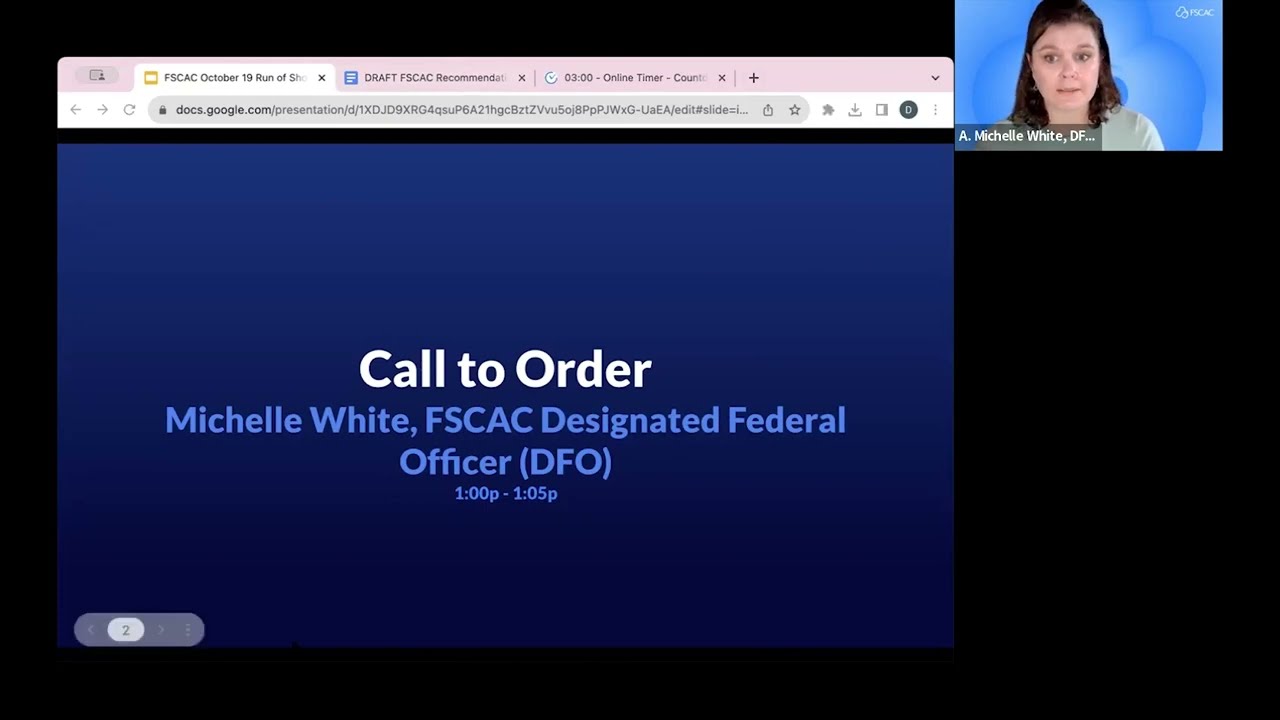 Play the video: FSCAC October 19 2023 Meeting Recording
On October 19, 2023, the Federal Secure Cloud Advisory Committee (FSCAC) met online by Zoom. The FSCAC is the advisory committee that the FedRAMP Authorization Act requires. It gives advice and recommendations to the Administrator of the General Services Administration (GSA), the FedRAMP Board, and agencies. FedRAMP is the Federal Risk and Authorization Management Program. The committee's recommendations are advice. They do not change FedRAMP's rules.
The Federal Register notice announced four meetings that fall. It said this one would present the committee with information on the "Cloud Solution Provider (CSP) Authorization Path" and hold discussions "to develop draft recommendations."
The meeting came before the FedRAMP Consolidated Rules for 2026. In 2023, FedRAMP's approval was called a "FedRAMP authorization," and the three designations on the FedRAMP Marketplace were FedRAMP Ready, In Process, and FedRAMP Authorized. Speakers also referred to an agency's authorization to operate (ATO). The current terms are "FedRAMP Certification" and "FedRAMP Certified." FedRAMP's What's Changing in 2026 page explains the change.
Quotations in this post are words from the meeting recording, checked against its captions. The post names speakers by their role.
In short:
- What FedRAMP said. FedRAMP's program manager of security operations said a cloud offering took a little over seven months to reach authorization. Poor package quality was one of the biggest causes. Every package FedRAMP authorized in its analysis of fiscal years 2022 and 2023 needed rework.
- What members proposed. Ideas included clearer and more current templates, published lists of common issues, attestations from agencies and cloud service providers (CSPs), control inheritance from other programs, a matrix of shared responsibilities for software as a service (SaaS), and enough resources for FedRAMP.
- What the committee decided. Nothing that day. GSA's minutes record no vote. Members said they would vote on November 9, 2023.
- What it means for agencies and cloud providers. Two of the ideas, control inheritance and a SaaS responsibility matrix with an assessment process, later appeared in the committee's recommendations memo on 2023 priorities to the GSA Administrator. The memo also asked for fuller security package documentation.
Source: the October 19, 2023, meeting video. FedRAMP's process and terms have changed since then.
Read the steps as text
- Readiness assessment. A third-party assessment organization (3PAO) checks the provider's key capabilities. Passing FedRAMP's review earns the FedRAMP Ready designation.
- Agency partner. The provider finds an agency partner, and the offering is In Process. The two plan the work and agree on a work breakdown structure.
- Kickoff. FedRAMP's Program Management Office (PMO) holds a kickoff meeting with the agency, provider, and 3PAO.
- Full assessment. The 3PAO tests the system against the FedRAMP baseline and writes a security assessment report. The provider writes a plan of action and milestones.
- Agency review. The agency reviews the package, and its authorizing official issues an ATO.
- FedRAMP review. The PMO reviews the package for quality and risk, so other agencies can reuse it.
- Authorized. The offering is listed as FedRAMP Authorized and goes into continuous monitoring. Today the term is FedRAMP Certified.
Why did authorizations take so long in 2023?
FedRAMP's program manager of security operations gave the briefing. The speaker said the program could not keep up with demand:
"Currently, it takes a little over seven months for a cloud offering to achieve authorization." — FedRAMP's program manager of security operations
The speaker said most packages had issues that made the 3PAO clarify or retest controls. Common issues included missing encryption, use of unauthorized external services, unclear authorization boundaries, and control descriptions that did not match the test results. Submissions were rising, especially for high impact systems, which need more review.
FedRAMP studied 105 packages submitted in fiscal years 2022 and 2023. The speaker gave these averages: 54.5 days before FedRAMP began reviewing a package in its queue, and, for the 79 packages it authorized, 22 days of review and 84.5 days of fixes:
Source: FedRAMP's briefing in the October 19, 2023, FSCAC meeting video. The wait is for packages in FedRAMP's queue. The review and fixes are for the 79 packages FedRAMP authorized out of 105 in its analysis.
Show the numbers
| Average days | |
|---|---|
| Waiting for FedRAMP to start the review | 54.5 |
| FedRAMP's review | 22 |
| Provider and 3PAO fixing issues | 84.5 |
From submission to authorization took an average of 5.37 months. Every one of the 79 packages needed remediation. The speaker said a clean package would need far less time:
"Typically a package free of major quality issues takes our team on average six days to complete." — FedRAMP's program manager of security operations
The speaker said FedRAMP had grown its review team from four reviewers to about 12, but the timeline had not improved.
What changes did FedRAMP say it was exploring?
The speaker listed ideas FedRAMP was considering at the time:
- A faster review for offerings that had already reached FedRAMP Ready.
- An outside process expert from GSA's Centers of Excellence to suggest a better team structure.
- A review of which controls matter most for a decision.
- Trusted agency partners that would check a standard list of requirements, so FedRAMP could do a shorter quality check.
- Agencies working together to issue one authorization.
- Tools built on the Open Security Controls Assessment Language (OSCAL), a machine-readable format for security packages.
On 3PAO quality, the speaker described three steps: a consultation, then an "in remediation" status with a plan FedRAMP must accept, and then possible removal from the program. Asked about pilots for members that already use governance, risk, and compliance (GRC) tools, the speaker said FedRAMP planned an early adopters workshop in the next calendar year.
A member from the National Institute of Standards and Technology (NIST) asked about funding and said:
"as you grow exponentially, this is not something you're going to be able to hire your way out of." — FSCAC member from NIST
What did members say the problem was?
The Designated Federal Officer (DFO) led the discussion because the chair had technical problems. Members first asked about scope. Several asked to look at the whole authorization lifecycle, not only FedRAMP's final review. The DFO agreed.
Members named these problems:
- Packages reached FedRAMP with quality gaps, even after an agency sponsor worked on them.
- Most of the work was still manual.
- Finding a sponsoring agency was hard, and many agencies lacked staff who knew FedRAMP.
- Many people assumed any cloud service needs FedRAMP.
A member from a large cloud provider asked whether FedRAMP could offer a faster path for urgent needs. Another member objected:
"I have serious qualms about federal government having a government wide exception process that takes the control out of the hands of CIOs." — FSCAC member
CIO means chief information officer. A small business member said a faster process must also cost providers less.
What did members recommend?
Members proposed these ideas during the meeting:
- Set a time limit for agency review of an In Process offering.
- Update templates and control guidance on a set schedule, so they match.
- Publish the common issues FedRAMP sees, quarterly or twice a year.
- Have the sponsoring agency and provider check the package against FedRAMP's checklist and attest to it before they submit.
- Assess agency processes, so mature agencies could skip FedRAMP's review.
- Allow sponsorship by more than one agency, and pair new agencies with experienced ones.
- Set and measure response times for each phase.
- Make reviewers interpret controls the same way.
- Accept testing evidence from other programs, such as International Organization for Standardization (ISO) certifications.
- Build a matrix of inherited and shared responsibilities, and a SaaS assessment process.
- Pilot OSCAL and give providers reasons to adopt it.
- Give FedRAMP the resources to carry out accepted recommendations.
GSA's minutes group the ideas as key measures, transparency and training, the review process, review scope, automation, and resources. The November 9 meeting postponed the vote. Members voted on January 18, 2024, as GSA's January minutes record. The memo on 2023 priorities lists three authorization path recommendations: control inheritance, security packages that include baselines and deployment guides, and a matrix of fully inherited and hybrid responsibilities with a SaaS assessment process.
Sources
- FedXchange tracker: FSCAC October 19 2023 Meeting Recording
- YouTube: FSCAC October 19 2023 Meeting Recording
- GSA: FSCAC October 19, 2023, meeting agenda and minutes
- GSA: FSCAC January 18, 2024, meeting agenda and minutes
- GSA: FSCAC recommendations memo on 2023 priorities
- Federal Register: FSCAC notification of upcoming meetings, September 25, 2023 (2023-20661)
- GSA: Federal Secure Cloud Advisory Committee meetings
- GSA: Federal Secure Cloud Advisory Committee
- FedXchange: FSCAC, November 9, 2023, draft memo vote postponed
- FedXchange tracker: FedRAMP Authorization Act (Public Law 117-263, section 5921)
- FedXchange tracker: FedRAMP Consolidated Rules for 2026
- FedRAMP: What's Changing in 2026
Get new posts and federal governance by email
A weekly email on Fridays, an alert on the day the watch finds something new, or both. Free.