FSCAC, October 26, 2023: FedRAMP briefs the committee on continuous monitoring, and members draft ideas to fix it
On October 26, 2023, FedRAMP's acting director told the Federal Secure Cloud Advisory Committee that review teams spent about 80% of their time on continuous monitoring. Members drafted ideas but took no vote. Their recommendations are advice, not rules.
By FedXchange ·
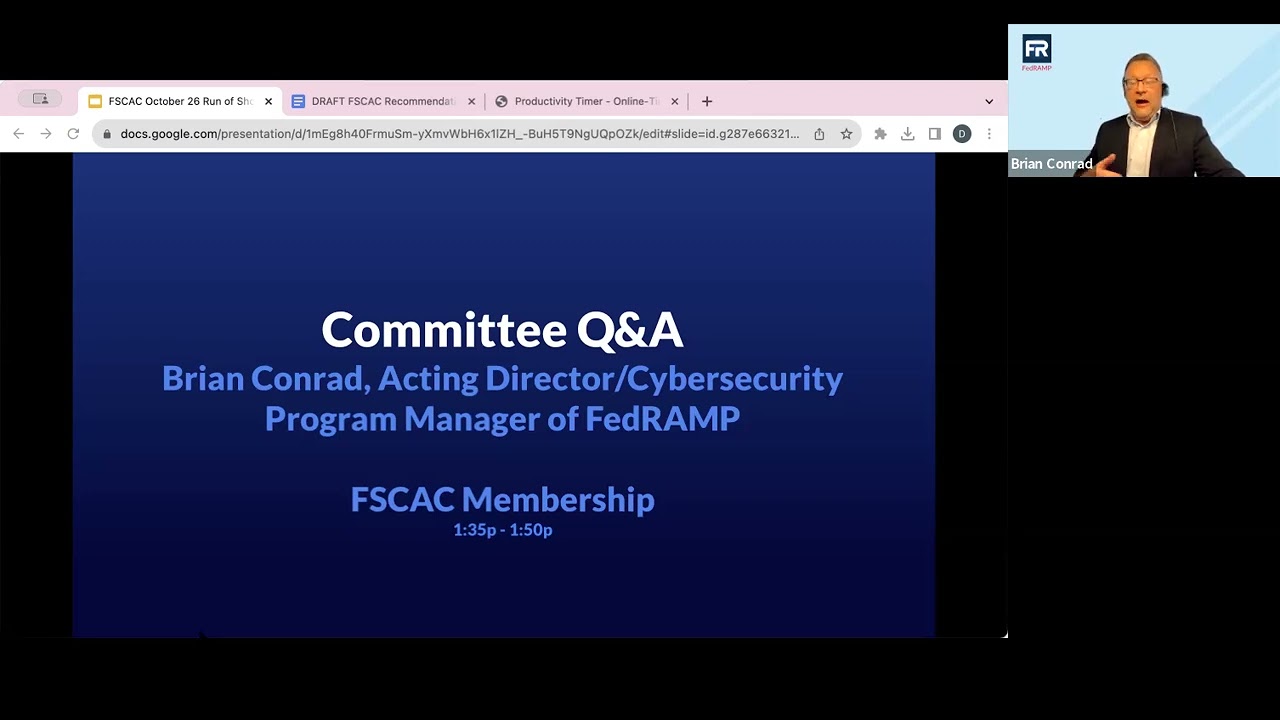 Play the video: Federal Secure Cloud Advisory Committee (FSCAC) October 26 2023 Open Meeting
On October 26, 2023, the Federal Secure Cloud Advisory Committee (FSCAC) met online by Zoom. The FSCAC is the advisory committee that the FedRAMP Authorization Act requires. It gives advice to the Administrator of the General Services Administration (GSA), the FedRAMP Board, and agencies. FedRAMP is the Federal Risk and Authorization Management Program. The committee's recommendations are advice. They do not change FedRAMP's rules.
The Federal Register notice said this meeting would give the committee "additional information on the Continuous Monitoring (ConMon) process" and hold discussions "to develop draft recommendations." ConMon is the work a cloud provider and its customers do after approval to keep a cloud service secure. The chair was absent. GSA's minutes record that the Designated Federal Officer (DFO) led the meeting in the chair's place.
The meeting came before the FedRAMP Consolidated Rules for 2026. In 2023, FedRAMP's approval was called a "FedRAMP authorization." Speakers also referred to the Joint Authorization Board (JAB) and to an agency's authorization to operate (ATO). The current terms are "FedRAMP Certification" and "FedRAMP Certified." FedRAMP's What's Changing in 2026 page explains the change.
Quotations in this post are words from the meeting recording, checked against its captions. The post names speakers by their role.
In short:
- What FedRAMP said. FedRAMP's acting director said ConMon was largely manual, and that approval of significant changes was too slow. FedRAMP was setting up a ConMon lane in its Program Management Office (PMO) and hiring a federal employee to lead it.
- What members proposed. Ideas included faster automation, sending ConMon data to agencies through the Cybersecurity and Infrastructure Security Agency's (CISA's) Continuous Diagnostics and Mitigation (CDM) program, interim steps before automation, minimum standards, and centralizing ConMon for agency-sponsored offerings in FedRAMP.
- What the committee decided. Nothing that day. GSA's minutes record no vote.
- What it could mean for agencies and cloud providers. Three ConMon recommendations later appeared in the committee's recommendations memo on 2023 priorities. They are advice to the GSA Administrator.
Sources: the October 26, 2023, meeting video, the Federal Register notice, GSA's minutes for October 26 and November 9, 2023, and January 18, 2024, and the FSCAC's recommendations memo on 2023 priorities. The recommendations are advice, not FedRAMP rules.
Read the steps as text
- September 25, 2023. A Federal Register notice announced a meeting on the ConMon process for October 26.
- October 26, 2023. FedRAMP's acting director briefed members on ConMon problems and plans.
- October 26, 2023. Members listed problems, goals, considerations, recommendations, and effects on each group in a live draft. No vote.
- November 9, 2023. Members reviewed the draft deliverable. The vote was moved to a later meeting.
- January 18, 2024. Members unanimously approved three top ConMon recommendations.
- Recommendations memo. The memo on 2023 priorities lists three ConMon recommendations for the GSA Administrator.
What problems with continuous monitoring did FedRAMP describe?
FedRAMP's acting director said JAB reviewers came from three agencies and applied policy differently. Agency customers could not always see the status of a significant change request (SCR) until it was approved. Letters asking a provider for a corrective action plan were slow to go out.
The acting director said ConMon has two parts. FedRAMP checks that providers meet its requirements. The agency authorizing official (AO) manages the risk. FedRAMP planned automation, including the Open Security Controls Assessment Language (OSCAL), a machine-readable format for security packages. It also planned a knowledge management system so staff apply FedRAMP policy in a firm, fair, and consistent way.
The acting director said FedRAMP might use threat-based scoring of controls to choose which controls an annual assessment covers. A member from Palo Alto Networks asked whether FedRAMP would expect system security plans and ConMon reports in OSCAL. The acting director said, "Eventually, yes."
The acting director also said the JAB turns monthly scan data into one-page summaries with a year of vulnerability history. Those were posted to a repository site that the Office of Management and Budget (OMB) runs, called MAX. FedRAMP was working with CISA's CDM program to send that kind of information to agency AOs instead.
"the authorization is not the end state. The authorization is just the beginning" — FedRAMP's acting director
How much did continuous monitoring cost?
A member from the Department of Defense (DoD) gave a cost figure and asked FedRAMP to look at it:
"every 20 cloud providers that we add costs $1.3 million to just do ConMon" — FSCAC member from the Department of Defense
Asked about FedRAMP's own budget for ConMon, the acting director gave a rough estimate for the JAB review teams:
"80% of their time is spent on continuous monitoring versus 20% of, you know, towards initial authorizations." — FedRAMP's acting director
The acting director said FedRAMP had not looked at an interim solution for the time before automation. A member from GSA said the 80/20 split leaves less money for new packages and slows approvals:
"So, you know, a fix to ConMon, I think, is a fix to FedRAMP." — FSCAC member from GSA
What problems and goals did members name?
The DFO asked members for problem statements, goals, considerations, recommendations, and effects on each group, in that order. Members said ConMon was manual, costly, and labor intensive. Members also said it did not give agencies enough view of risk.
The GSA member said monthly operating system, web, and database scans may miss risks in newer designs, such as microservices. A member from a cloud provider agreed:
"I know as a CSP, it seems like we spent half our time chasing false positives" — FSCAC member from a cloud service provider (CSP)
The GSA member said JAB and agency ConMon differed, and that weak agency ConMon could become "a race to the bottom." A member from the Securities and Exchange Commission said no one official can accept risk for the whole government, because that authority rests with each agency's chief information officer (CIO). One member asked how to make ConMon workable for small companies. Another member said:
"The goal is not cost reduction. The goal is to improve the security of the federal enterprise." — FSCAC member
Members also debated the customer responsibility matrix (CRM). The GSA member said the CRM is too high level, so GSA writes its own secure configuration profiles. The DoD member said DoD writes tenant configuration guides. Another member said such guides belong in the package as an addendum, not in the CRM.
What did members recommend?
Members proposed these ideas during the meeting:
- Speed up automation and the move of ConMon data into a CISA environment.
- Build an integrated governance, risk, and compliance (GRC) tool for agency and FedRAMP packages.
- Publish a timeline for automating ConMon, from the view of the PMO, providers, and third-party assessment organizations (3PAOs).
- Use interim steps, such as doing ConMon every other month or once a quarter, as DoD had done.
- Set a minimum standard for findings and for what counts as a significant change.
- Review what the monthly scans must cover.
- Centralize ConMon for agency-sponsored offerings in FedRAMP, with a risk score for each agency and each provider through CDM.
- Measure cost and performance, and fund both new packages and ConMon.
One member of the public asked whether the committee had seen OMB's draft FedRAMP guidance. The DFO said public comment was one way only. OMB released the draft memo on October 27, 2023. OMB issued its final memo, M-24-15, on July 25, 2024.
GSA's January 18, 2024, minutes record that members unanimously approved three top ConMon recommendations. The memo lists them: an integrated tool such as a GRC tool, adding ConMon to existing streamlining work such as OSCAL and electronic governance, risk, and compliance (EGRC), and "centralizing ConMon processes for agency authorizations within the FedRAMP framework." A separate FedXchange post on the October 19, 2023, meeting covers the authorization path briefing.
Sources
- FedXchange tracker: Federal Secure Cloud Advisory Committee (FSCAC) October 26 2023 Open Meeting
- YouTube: Federal Secure Cloud Advisory Committee (FSCAC) October 26 2023 Open Meeting
- GSA: FSCAC October 26, 2023, meeting agenda and minutes
- GSA: FSCAC November 9, 2023, meeting agenda and minutes
- GSA: FSCAC January 18, 2024, meeting agenda and minutes
- GSA: FSCAC recommendations memo on 2023 priorities
- Federal Register: FSCAC notification of upcoming meetings, September 25, 2023 (2023-20661)
- GSA: Federal Secure Cloud Advisory Committee meetings
- GSA: Federal Secure Cloud Advisory Committee
- OMB: Draft memorandum for modernizing FedRAMP, October 27, 2023
- FedXchange tracker: OMB M-24-15
- FedXchange tracker: FedRAMP Authorization Act (Public Law 117-263, section 5921)
- FedXchange tracker: FedRAMP Consolidated Rules for 2026
- FedRAMP: What's Changing in 2026
- FedXchange blog: FSCAC, October 19, 2023, authorization path briefing
Get new posts and federal governance by email
A weekly email on Fridays, an alert on the day the watch finds something new, or both. Free.